Most discussions about an AI bubble follow a familiar script. Technology companies are committing hundreds of billions of dollars to data centers, chips and power. If future revenues fail to justify those investments, valuations fall, investment contracts and the market gets its own version of the dot-com crash.
The facts behind that concern are real. The causal story may still be incomplete.
There is another scenario worth testing: the AI bubble may not burst because artificial intelligence turns out to be useless or overhyped. It may burst because useful intelligence becomes too cheap, too available and capable of running on increasingly inexpensive hardware faster than parts of today’s infrastructure can earn the returns currently assumed.
This is not a prediction of an inevitable crash. It is a measurable hypothesis.
The price of the same level of intelligence is falling
In September 2026, Epoch AI published The Plunging Price of Thought. Rather than comparing token prices or particular model brands, the researchers estimated the minimum cost required to achieve a fixed level of AI performance.
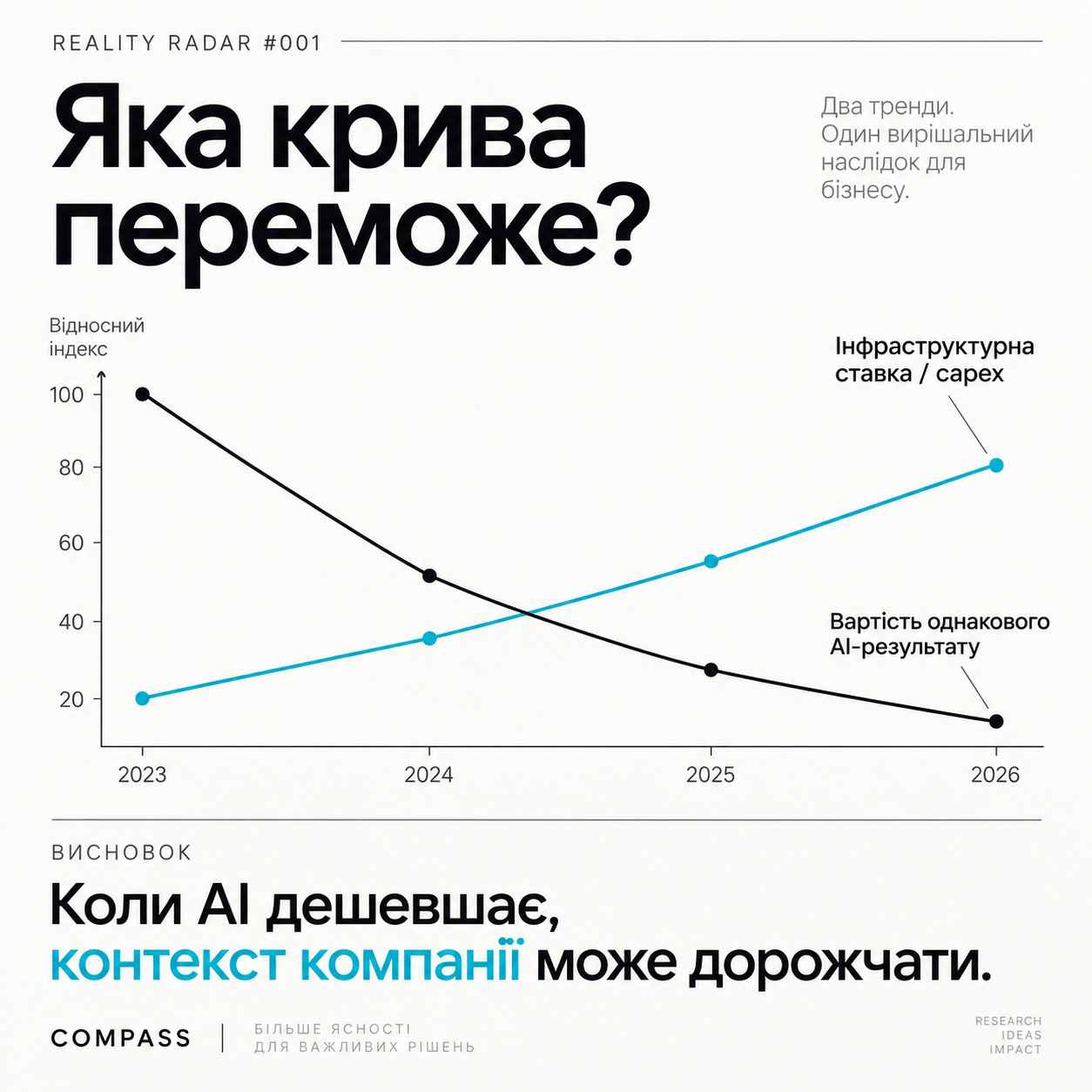
Their finding: since 2023, the cost of a given level of AI performance has fallen by roughly 47% per quarter, or about 13 times per year. They estimate this decline has been faster than the historical cost declines of computing, lithium-ion batteries, DNA sequencing and electricity. [1]
At the same time, the infrastructure bet keeps expanding. Reuters estimated in July 2026 that capital expenditure by Microsoft, Alphabet, Amazon, Meta and Oracle could exceed their combined free cash flow by 2027 on the current trajectory. For every additional dollar of operating cash flow between 2025 and 2027, the forecast implied roughly $1.57 in additional spending. [2]
By late September, Reuters was also documenting rising scrutiny in AI credit markets, higher financing costs and growing pressure on projects whose future economics have not yet been proven. [3]
Two curves are moving toward each other.
The first is the cost of obtaining a unit of useful intelligence.
The second is the amount of capital being committed to infrastructure intended to produce it.
The relationship between those curves is the real object of this research.
AI is already beginning to change where it runs
Microsoft now supports ready-to-use local language models on Windows. Foundry on Windows offers models that can run directly on users’ machines, while Windows ML supports running additional compatible models locally. [4]
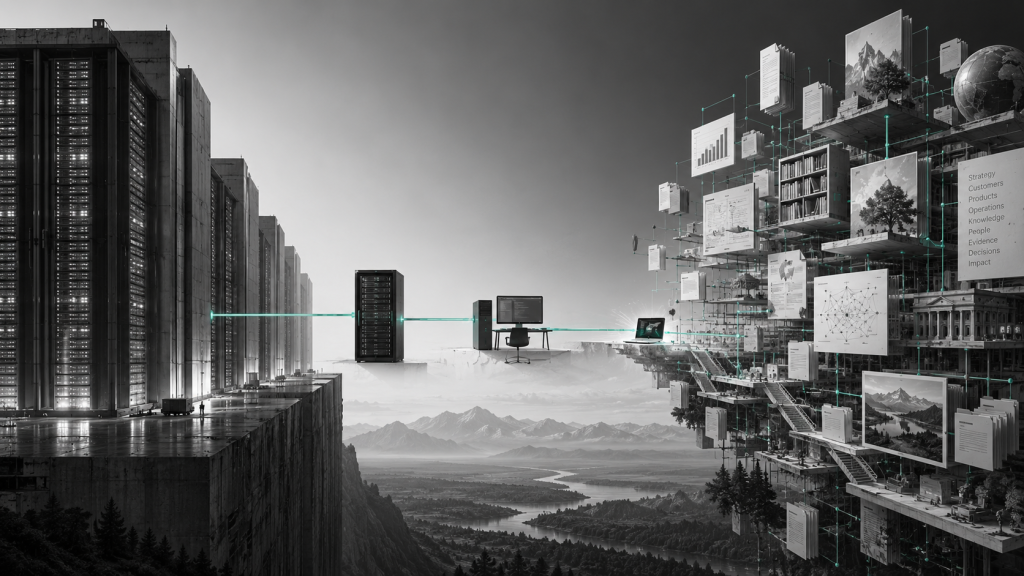
This does not mean hyperscale data centers disappear. Frontier training, the largest models, millions of simultaneous users and the most demanding workloads will continue to require enormous centralized infrastructure.
But every task no longer has to be sent to the largest model in the largest data center.
Routine work can move to smaller models.
Sensitive corporate work can stay inside the company.
Persistent personal agents can move closer to the user.
The hardest problems can escalate to frontier systems.
So "Will AI become huge?" is not a very useful question. It probably will.
A better question is: where will the work actually run, how much will it cost, and what remains scarce when access to capable models becomes dramatically cheaper?
PATTERN 1. PREDICTION
What Pattern 1 means
Pattern 1 is not a summary of a signal. We ask what new normal follows if the change continues, who benefits, who loses and which current assumptions stop working.
Our forecast
The AI bubble could burst not because AI fails, but because the economics of the first AI architecture prove wrong.
If the cost of achieving the same useful result falls faster than total AI workload grows, some infrastructure built on the assumption of prolonged scarcity in expensive centralized intelligence may produce weaker returns than the market currently expects.
That does not imply less AI. The opposite is possible: AI becomes ubiquitous precisely because it becomes cheap.
The mechanism:
same-quality result becomes cheaper
-> more tasks can move to smaller models and cheaper machines
-> some work moves closer to companies and users
-> the structure of infrastructure demand changes
-> economic value migrates toward new scarcities.
The strongest counterargument is already visible. Gartner forecasts that inference cost per complete agentic workflow could increase more than fivefold through 2028 even while individual model operations become cheaper. Agents simply perform far more steps. [5]
Our hypothesis is therefore wrong if growth in AI workload continues to outpace efficiency gains.
What this demonstrates in ARCHYX
The first capability of an Operating System for Creating New Reality is seeing a shift before it becomes obvious. In our architecture, this is New Reality Radar: weak signals -> mechanism -> testable opportunity hypothesis -> falsifier -> decision.
Six indicators will test Pattern 1:
1. Cost of achieving the same AI result.
2. Minimum hardware cost required for a result at quality level X.
3. Share of AI work performed outside the largest clouds.
4. New capital investment per additional dollar of AI revenue.
5. Market price of scarce AI hardware and rental capacity.
6. Growth in new AI workload caused by falling prices.
PATTERN 2. UTILIZATION
What Pattern 2 means
After forecasting the shift, we ask the practical question: if this is happening, what can a company begin doing before competitors?
The weak strategy is to treat AI as the purchase of another software product.
If models become commodities, early advantage does not come only from access to the technology. It accumulates through use.
A company that starts earlier accumulates:
– decision history;
– mistakes;
– rules and exceptions;
– customer evidence;
– causal hypotheses;
– verification methods;
– new roles;
– quality standards;
– outcome history.
Three years from now, a late adopter may be able to buy the same model. It cannot buy three years of well-structured organizational learning with one payment.
The practical bet is therefore not "put AI everywhere".
A stronger bet is to turn every important decision into a structured chain:
DECISION
-> WHY
-> ACTION
-> RESULT
-> EVIDENCE
-> WHAT CHANGED.
Ordinary operating activity begins to create a new asset.
What this demonstrates in ARCHYX
This is the second capability of ARCHYX: not merely seeing a new reality, but rebuilding the company so it can act inside it.
CompanyGraph, Company OS and the Experience, Evidence & Learning Plane exist to stop experience from remaining trapped in the owner’s head, meetings, chats and random documents. They turn it into versioned operational memory.
PATTERN 3. CREATION
What Pattern 3 means
Pattern 3 begins when we stop asking how to adapt to someone else’s future. We ask what new asset, category or rule of the game can be created from the shift we have detected.
Our bet: Company Context Capital
If capable models become cheap and widely available, one of the new scarcities is context that cannot be purchased instantly.
Two companies can use the same model.
One knows today’s documents.
The other has systematically recorded for five years:
– what it decided;
– why;
– which assumptions it made;
– which signals it saw;
– what it did;
– what actually happened;
– under which conditions the decision worked or failed.
The AI models may be identical. The companies’ decision capability is not.
We call this asset Company Context Capital.
But there is an important constraint: not every pile of information becomes capital. A million old files with no causal structure and no outcome linkage can be an information landfill.
What compounds in value is structured, dated, verified context connected to consequences.
ARCHYX therefore needs an evidence chain, not a document dump:
signal
-> hypothesis
-> decision
-> action
-> result
-> verification
-> learning.
Super Core
At the level of one company, this context remains its private asset.
At the ARCHYX level, a different asset can emerge from cases that are lawfully available for learning and are de-identified or pseudonymized where direct identity is unnecessary.
Not: "Company X did Y."
Instead:
under conditions A+B, problem class C often has causal mechanism D;
intervention E works under these conditions;
fails under these;
normally requires this cost and time;
requires these capabilities;
has these failure modes;
produces this verified effect.
In our architecture, that becomes a Super Core built from:
BUSINESS PROBLEM STRUCTURES
x CAUSAL PATTERNS
x CAPABILITY PACKS
x APPLICABILITY CONDITIONS
x INSTALLATION COST / TIME
x FAILURE MODES
x VERIFIED BUSINESS EFFECT.
Each next company receives more than an AI model. It receives a system that has already learned from previous verified realities.
What this demonstrates in ARCHYX
The third capability is the Reality Creation Engine.
ARCHYX does not end with analysis or automation. The full loop is:
detect a possible new reality
-> select it
-> construct an alternative model
-> create an experiment
-> assemble the capabilities
-> produce an external effect
-> verify it independently
-> convert the result into learning
-> improve the next version of the system.
That is an Operating System for Creating New Reality.
The main conclusion
Today the market is obsessed with who has the largest model and the largest infrastructure.
If the price of useful intelligence continues falling at anything close to its recent rate, the question gradually changes.
Not: "Which AI did you buy?"
But:
"What does your AI know about your company that your competitor’s AI does not, and is that knowledge connected to verified outcomes?"
If this hypothesis is right, companies are already creating one of the most important assets of the next decade, even though it does not yet appear on their balance sheet.
We will test this hypothesis publicly through Reality Radar.
If this way of looking at change is useful to you, subscribe to the next issues. We are not trying to guess the future. We collect signals, build falsifiable patterns and ask what new realities can be created from them.
Method note
This analysis was produced using the Pattern Intelligence Method.
Pattern 1 – Prediction: what the change may foreshadow.
Pattern 2 – Utilization: how to use the shift before the market.
Pattern 3 – Creation: what new asset, market or rule can be created from it.
The original three-level frame Pattern Recognition -> Pattern Utilization -> Pattern Creation was articulated by Tony Robbins in conversation with Peter Diamandis on Moonshots & Mindsets. Compass Pozhidaev Research Institute is developing it into a repeatable protocol for weak signals, causal mechanisms, forecasts, falsifiers and pattern creation. [6]
Sources
[1] Epoch AI – The Plunging Price of Thought. Published September 22, 2026. Key finding: cost of a given level of AI performance fell about 47% per quarter since 2023, about 13x per year.
[2] Reuters – AI investment boom puts Big Tech’s free cash flow under pressure. Published July 22, 2026. Key finding: Microsoft, Alphabet, Amazon, Meta and Oracle could see combined capex exceed combined free cash flow by 2027; about $1.57 of additional spending per $1 of additional operating cash flow in the cited forecast.
[3] Reuters – Are AI credit cracks a warning, or a ‘buy’ signal? Published September 29, 2026; and AI borrowers face tough sell in risky corners of US credit market, September 30, 2026. Use as current evidence of financing scrutiny, not as proof that the bubble has already broken.
[4] Microsoft Learn – Ready-to-use local LLMs on Windows. Foundry on Windows provides ready-to-use local LLMs; Windows ML supports compatible local models.
[5] Gartner – AI Inference Costs Per Agentic Workflow Will Increase More Than Fivefold Through 2028. Published August 17, 2026. This is the primary falsification pressure against the simple "cheaper models mean less infrastructure" thesis.
[6] Peter Diamandis / Moonshots & Mindsets – How to Create a Successful Life With Tony Robbins. Provenance source for the original Pattern Recognition -> Pattern Utilization -> Pattern Creation frame discussed in the series.