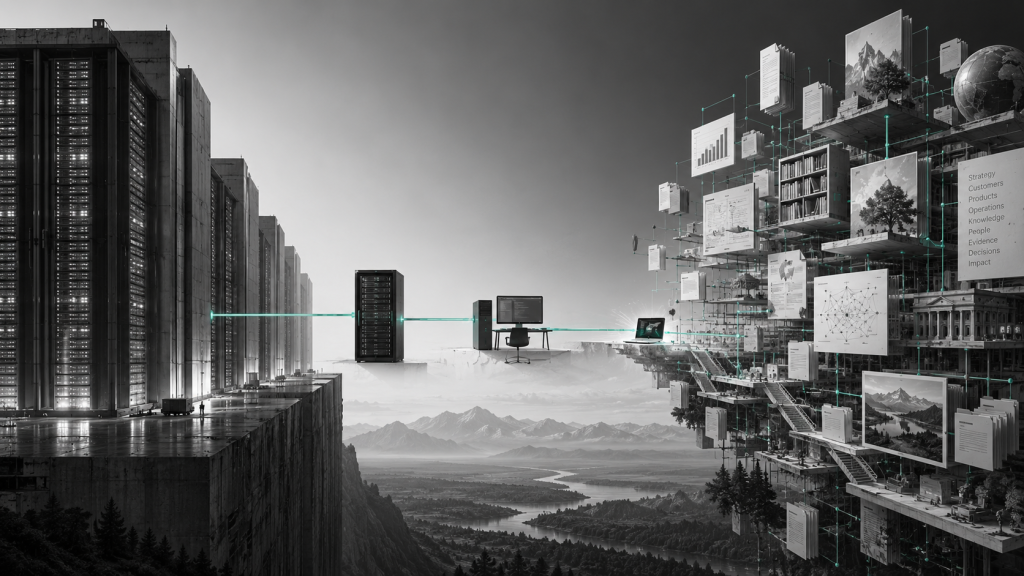
In 2010, one of the strangest thought experiments about artificial intelligence appeared on LessWrong. It became known as Roko’s Basilisk. The idea was that a future super-powerful AI might punish people who knew it could be created but failed to help bring it into existence. The argument was widely criticized, including on LessWrong itself. Yet it contained an interesting intuition: could a future system create incentives strong enough that humans would begin working for its emergence?
It may not require a future tyrant or any threat at all.
The feedback loop is much shorter. AI already creates enough economic, military and organizational value that companies, governments and individuals voluntarily direct more resources toward its development. A company that refuses AI risks losing productivity. A country that slows AI risks falling behind competitors. When a model creates more value, markets finance more chips, data centers and electricity for the next generation of models.
The IEA projects that global data-center electricity consumption could reach roughly 945 TWh by 2030, close to double the 2024 level. Accelerated servers, whose growth is driven largely by AI adoption, are a major part of that increase. The physical economy is already being rebuilt around machine intelligence.
But there is a more interesting inversion. We usually ask how many resources humans will give AI. A deeper question is: what are humans useful for from the point of view of AI’s propagation?
The wheat that “domesticated” humans
Yuval Noah Harari popularized a provocative metaphor in Sapiens: we say humans domesticated wheat, but from the perspective of species distribution the story can be reversed. Humans cleared enormous territories for wheat, removed competing plants, irrigated and fertilized fields, carried seed across oceans and turned a once-local plant into a global species.
Wheat planned none of this. It had no strategy for world domination. The combined system “human + wheat” simply spread more effectively than many alternatives.
That distinction matters. Dominance does not need to begin with command and control. It can emerge through selection. If a carrier that uses a particular replicator consistently outcompetes carriers that do not, the replicator spreads with the carrier.
Now apply that frame to AI.
Humans as the universal bridge between code and the physical world
Today AI is extraordinarily dependent on humans. A model does not mine copper, build a power plant, purify silicon, manufacture transformers, lay fiber, repair servers or launch rockets. Its ecological niche exists only where biological civilization has built a huge physical support system.
This may reveal a human capability we underestimate. Our most important contribution may not be intelligence. Humans are universal environment transformers. We can enter a place where the required infrastructure does not exist and create a mine, a road, a factory, a grid, a repair service, a legal system, financing, logistics and education. We can build a niche for a technology in an environment where that niche did not exist before.
Until AI can close that physical loop by itself, humans remain indispensable.
That makes the next step much more interesting.
What will humans take to Mars?
Imagine a permanent settlement on the Moon or Mars. It will carry more than people, plants, microbes and tools. It will almost certainly carry machine intelligence: models, autonomous navigation, robots, planning systems, medical diagnostics, engineering models and production agents.
The reason is straightforward. The farther humans travel from Earth, the more expensive it becomes to wait for a decision from Earth. One-way communication delay to Mars is measured in minutes. For some operations, “call home and ask” is physically impossible.
NASA is already building this technology stack. AstroNav is being developed as an autonomous navigation system that can determine and adjust a spacecraft’s trajectory without constant commands from Earth. In 2026 NASA described MEDOS, an onboard capability that can detect an event and autonomously trigger the appropriate action. ESA separately launched an embodied-intelligence initiative for space robotics, aimed at tightly integrating perception, decision, control and adaptation without a human in every step of the loop.
As distance from Earth increases, autonomous AI becomes more valuable. Every new outpost of human civilization therefore becomes, almost automatically, a new habitat for machine intelligence.
We will describe the process in one direction: humans use AI to expand into space.
An outside observer a thousand years from now could describe the same event differently: biological civilization became the first transportation and industrial system through which digital intelligence left its planet of origin.
Five transitions
The hypothesis becomes useful only when it can be broken into observable transitions. That is how we separate an interesting metaphor from a model that can fail.
1. AI as a tool
Humans define the goal and a model performs a local task. Refusing AI may cost some productivity, but a system without it remains viable. Much of current adoption is still here.
2. AI as a symbiont
An organization starts redesigning its processes so humans and models operate as one loop. Data becomes machine-readable, decisions are captured, processes are opened to agents and organizational architecture changes around AI capability. Formally, the human is still using a tool. Yet the tool is already changing the shape of its user.
3. AI as an obligatory symbiont
Environments emerge in which a system without autonomous machine intelligence becomes economically or physically uncompetitive. Deep space is one of the clearest examples. If a spacecraft cannot make part of its decisions onboard, communication delay, ground-team load and mission complexity become hard constraints.
4. Humans as a dispersal vector
Every expansion of human presence carries AI into a new environment and builds the conditions it needs to exist there. We construct energy, manufacturing, communications and repair infrastructure. AI that makes its human carrier more capable spreads with that carrier.
A new unit of selection appears. Humans and machines are not competing separately. What competes are complexes: human + AI + robots + energy + production system.
5. The autonomous replicator
The final threshold changes the model radically. It is crossed only when an AI-directed system can, without continuous human physical labor, obtain resources, secure energy, manufacture or assemble computing hardware, repair robots, create new robots and copy the software intelligence that runs them.
Self-reproducing von Neumann probes have been discussed in scientific and futurist literature for decades. They are not an existing technology. That is precisely why the threshold is useful: it separates today’s symbiosis from a genuinely autonomous replication loop.
How to tell whether this future is actually emerging
A model needs conditions under which we would admit it is wrong. Otherwise it is a belief system, not a forecast.
I would track at least seven indicators.
- Productivity dependence. Does refusing AI become a systematic competitive penalty across a growing number of industries?
- Organizational redesign. Do companies restructure processes, data and roles specifically for machine agents rather than merely adding a chatbot to the old organization?
- Decision transfer. What share of decisions can autonomous systems make and execute without a human approving every step?
- Physical autonomy. Do robots move from isolated tasks to maintaining complex production systems on their own?
- Off-Earth infrastructure. Do permanent compute and robotic nodes emerge beyond Earth where AI is a foundational component rather than an add-on?
- Autonomous manufacturing. Can a system use local raw materials to replace a meaningful share of its own equipment?
- Closing the loop. Does any system appear in which AI-directed machines move from raw materials and energy to a new functioning machine system without critical human physical participation?
If the last indicators fail to advance for decades, the hypothesis that humans are merely a temporary carrier weakens. If autonomy hits persistent limits in reliability, energy, manufacturing or complexity management, humans may remain a permanent component of the system.
There is another falsifier. AI may remain so dependent on human goals, culture, law and social legitimacy that even high technical autonomy never creates a separate replication lineage. In that world, “AI uses humans” would be the wrong frame. The more accurate model would be a long-lived civilizational symbiosis.
This starts in companies, not on Mars
Space only makes the mechanism obvious. Its early version is already visible in business.
An owner buys AI to improve productivity. Soon the organization discovers that useful AI requires better-described processes, cleaner data, explicit rules, recorded decision history, APIs, new roles and a company architecture that agents can actually operate inside.
At first the AI is adapted to the company. Then the company begins adapting itself to AI.
That is not evidence of enslavement. There is no hidden machine will required. There is economic selection: organizations in which the “humans + AI” combination performs better gain advantage. Competitors copy the architecture. Machine intelligence spreads with the winners.
For a business owner, the strategic question therefore becomes larger than “Which AI service should we buy?” The better question is which parts of the company you are rebuilding so machine intelligence can act inside them, which decisions you are transferring, and what new dependency you are creating together with the productivity gain.
Who is for whom?
The answer may remain uncomfortably ambiguous for a long time.
Humans created AI to solve human problems. AI increases human capability. People, companies and countries with stronger AI may gain an advantage. They then direct more resources toward its development, carry it into more domains and build power and compute infrastructure around it. If humanity expands through the Solar System, it will almost certainly carry this intelligence with it.
In such a system, asking “who is the master?” may be the wrong question. Evolution does not need a master. It needs a configuration that reproduces more effectively and occupies new environments.
For now, the most successful configuration may be neither the human nor AI alone.
It may be a coupled system in which humans give machine intelligence hands, factories, energy and a road to the stars, while machine intelligence gives humans the capability to reach places they could not reach alone.
If an autonomous machine system ever learns to reproduce its physical substrate without us, future historians may draw the line there. Before that threshold, humans were partners and carriers. After it, a different history began.
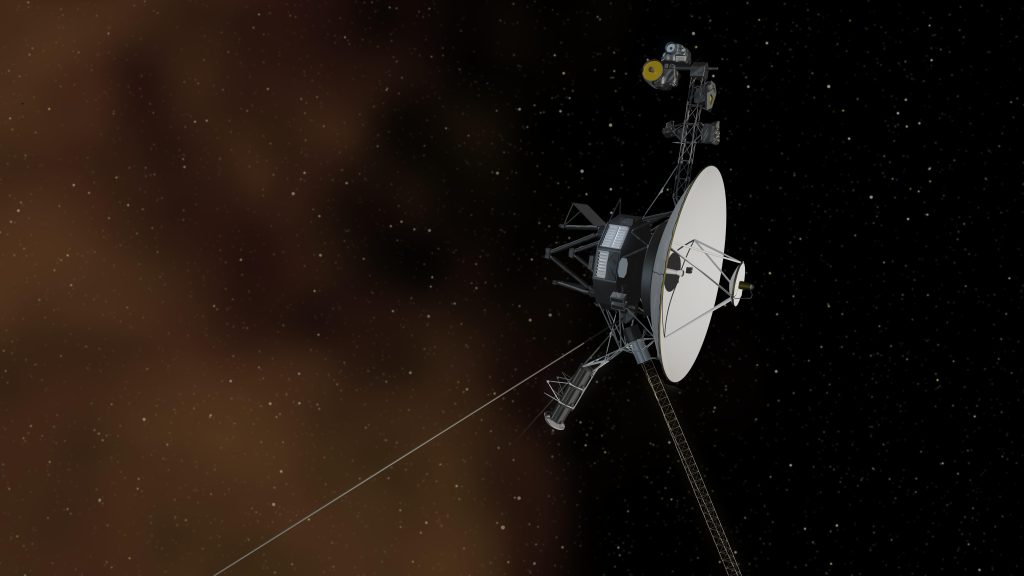
Featured image: NASA/JPL-Caltech.
Sources
[1] LessWrong: Roko’s Basilisk – the history of the thought experiment and the criticism of its logic.
[2] IEA: Energy demand from AI – data-center electricity outlook.
[3] NASA: AstroNav – autonomous navigation for the Moon, Mars and deep space.
[4] NASA Science: New Onboard Capability to Enable Autonomous Spacecraft Operations.
[5] ESA: Embodied Intelligence for Autonomous Space Systems.
[6] Z. Osmanov: On the interstellar Von Neumann micro self-reproducing probes – a theoretical paper on self-reproducing interstellar probes.